
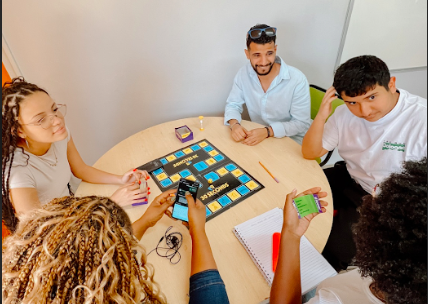
Many people struggle with English not because they lack ability, but because the classroom environment never made them feel comfortable enough to speak.
Too often, English classes feel careful and tense. Students focus on getting things right instead of communicating clearly. They wait their turn, second guess themselves, and worry about making mistakes in front of others. Over time, that pressure builds and confidence drops.
Language does not develop in that kind of space. It develops when people feel relaxed, supported, and encouraged to try.
An English classroom should feel like a place where speaking is natural, not stressful.
At its best, an English classroom should:
-
Feel safe enough for students to speak without fear
-
Encourage active use of English through conversation
-
Correct mistakes without interrupting confidence
-
Feel human, social, and interactive
-
Build confidence before focusing on perfection
A Classroom Should Feel Safe Before Anything Else
Students will not speak if they feel judged or constantly corrected. Safety in an English classroom means knowing that mistakes are expected and accepted as part of learning.
When students feel supported, they take more risks with the language. They speak sooner, speak more often, and improve faster. Confidence grows when students are allowed to try, adjust, and try again without embarrassment.
Research into learning environments shows that emotional safety plays a major role in how quickly people learn. When anxiety is reduced, progress increases. This relationship is explored in more detail by the British Council in their work on learning and emotional safety.
https://www.britishcouncil.org/education/skills/emotional-intelligence-learning
A safe classroom does not eliminate mistakes. It makes them useful.
English Should Be Used Actively, Not Just Studied
Listening and reading are important, but they are not enough on their own. English becomes natural when it is used in real conversation.
Students need opportunities to ask questions, respond to others, express opinions, and think out loud in English. This kind of active use helps learners build fluency and confidence at the same time.
Conversation focused learning allows students to practise English as it is actually spoken in daily life. English speaking courses that prioritise communication help learners move from understanding the language to using it comfortably.
https://englishaccess.co.za/
Watching and listening alone will not build confidence. Speaking does.
Correction Should Support Communication, Not Stop It
Mistakes are a necessary part of learning English, but how they are corrected matters. Constant interruption can make students hesitant and self conscious, which slows progress.
Effective correction allows students to finish their thoughts and stay engaged in conversation. Teachers listen first, respond naturally, and guide students toward clearer language without breaking their flow.
Research from Cambridge English highlights how supportive feedback helps learners improve accuracy while maintaining confidence and engagement.
https://www.cambridgeenglish.org/blog/the-role-of-feedback-in-language-learning/
When students feel heard and understood, they are more open to learning.
A Good English Classroom Feels Human and Interactive
Language is social. It includes tone, expression, timing, and reaction. A good English classroom reflects this reality.
Interaction, discussion, and shared moments all contribute to learning. When a classroom feels human rather than formal, students relax. When students relax, they communicate more naturally.
TESOL International emphasises the importance of interaction in language learning, noting that engagement with others is key to building fluency and confidence.
https://www.tesol.org/insights/articles/the-importance-of-interaction-in-language-learning
A classroom that feels too rigid often limits communication. A classroom that feels interactive invites it.
Confidence Matters More Than Perfection
Many adult learners delay speaking because they want to be perfect. Unfortunately, perfection often slows progress.
Students should leave class feeling more confident than when they arrived. They should feel encouraged to speak again, not focused on the mistakes they made.
Accuracy improves with use. Confidence comes first.
If your goal is to improve spoken English in real situations, the learning environment plays a major role in how quickly that confidence develops.
https://englishaccess.co.za/
Often, the Problem Is the Room
If learning English feels difficult, the issue is not always the language itself.
Often, it is the environment in which the language is being learned.
When the classroom feels supportive, active, and human, confidence grows naturally. Speaking becomes easier. Progress follows.
An English classroom should not feel intimidating. It should feel like a place where you are allowed to speak.
If you are ready to learn English in a classroom designed around confidence, conversation, and real communication, you can explore speaking focused courses and placement options here:
https://englishaccess.co.za/
Hi There
May I please have the information as I am interest in improving my English and I will be glad to start any time soon. I am working I will like to attend on Saturdays.
Good morning, can we email you the information on your gmail address?